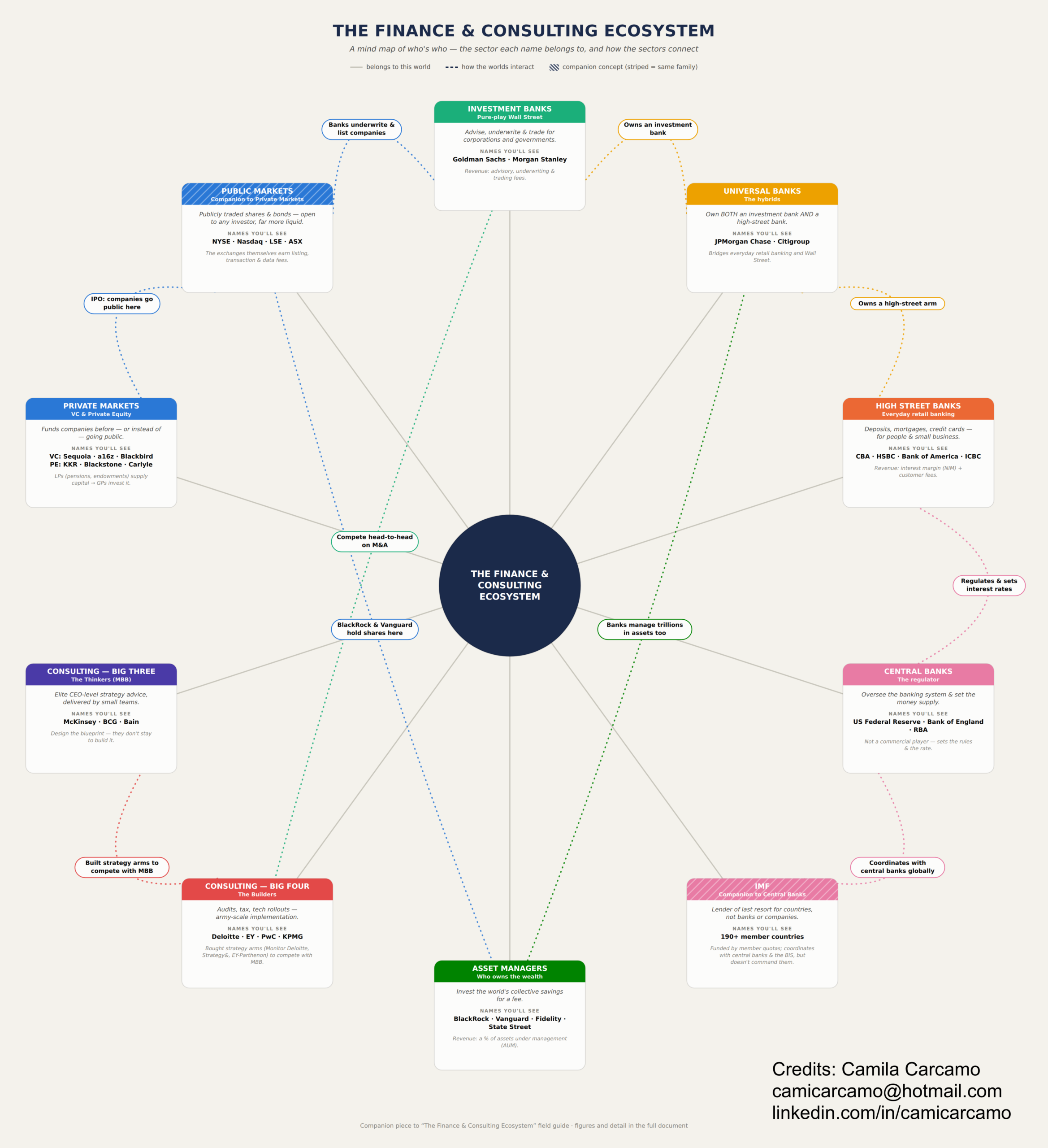
The Finance & Consulting Ecosystem
A field guide to who the players are, what they do, and how they connect
Camila Carcamo, August 2026
I wrote The Finance & Consulting Ecosystem because I find a strange kind of beauty in simplifying complex systems so they become easy to digest.
I think a lot of adult anxiety comes from not understanding the systems we live inside. When a name comes up in the news or in a meeting, and you don’t actually know what it does, it’s easier to tune out or pretend to know than to ask. Over time, that becomes a quiet exclusion from conversations that shape real decisions.
This guide is my attempt to close that gap. I wish I had it when I was getting started. This is not to make anyone an expert; it’s just to give the average person enough of a mental map that the next time BlackRock, McKinsey, or the Fed comes up, they already know roughly where it fits.
Money moves through a handful of recognisable worlds: the people who fund young companies, the banks that move capital and hold savings, the firms that manage the world’s investment wealth, and the consultants and advisors everyone else hires to make decisions. This guide walks through those worlds in the order money and companies actually pass through them. Starting with a startup raising its first cheque, and ending with the boardroom-level deals where banks and consulting firms compete head-to-head. The goal is simple: after reading this, a logo, a name, or a headline about any of these firms should immediately tell you what kind of company you’re looking at and what role it plays.
In This Guide
- How to Read This Map
- 1. Private Markets: How a Company Gets Funded
- 2. Banks: Where Companies (and Everyone Else) Go Next
- 3. Asset Managers: Who Actually Owns the World’s Wealth
- 4. Consulting & Professional Services: Who Everyone Above Hires
- 5. Where It All Collides: The M&A Battleground
- 6. Quick Reference: How Everyone Actually Makes Money
- 7. A Note on the Numbers
Money moves through a handful of recognisable worlds: the people who fund young companies, the banks that move capital and hold savings, the firms that manage the world’s investment wealth, and the consultants and advisors everyone else hires to make decisions. This guide walks through those worlds in the order money and companies actually pass through them. Starting with a startup raising its first cheque, and ending with the boardroom-level deals where banks and consulting firms compete head-to-head. The goal is simple: after reading this, a logo, a name, or a headline about any of these firms should immediately tell you what kind of company you’re looking at and what role it plays.
1. Private Markets: How a Company Gets Funded
Every company’s relationship with the financial system starts here; long before banks or public markets get involved. A company typically moves through a predictable funding lifecycle:
Founder capital → Angel / pre-seed → Venture capital → Growth equity → IPO → Public markets
The first four stages happen entirely in the “private markets”: deals negotiated directly between a company and its investors, out of public view. Only at the IPO stage does a company cross over into the “public markets”, where shares trade openly on an exchange. Both halves of the system matter, and understanding the difference reframes everything that follows:
Public Markets vs. Private Markets
| Public Markets | Private Markets |
|---|---|
| Publicly traded shares and bonds | Privately negotiated investments |
| More liquidity and price visibility | Less liquidity and less price transparency |
| BlackRock ETFs and public funds | VC, private equity, private credit and infrastructure |
| Available to broader investor groups | Often limited to institutional or qualified investors |
Primary Markets vs. Secondary Markets
A secondary market is a financial space where investors buy and sell existing securities, such as shares, bonds, or notes from other investors rather than from the company that first issued them. When you buy a stock on a major exchange, your money goes to the selling investor, not the company.
How It Works
- Peer-to-peer trade: Trades happen between individual or institutional traders.
- No issuer cash: The original creator of the asset gets no money from these sales.
How Stock Prices Are Set
In the secondary market, stock prices are not dictated by the company. Instead, they are driven entirely by supply and demand.
- The Bid-Ask Spread: Buyers state the maximum they are willing to pay (Bid), and sellers state the minimum they are willing to accept (Ask). A trade occurs when the two meet.
- Order Books: Exchanges use electronic matching engines to constantly pair buyers and sellers based on these prices.
- Market Sentiment: News, economic data, corporate earnings, and geopolitical events change how people value a stock, causing demand to spike or fall instantly.
Common Examples
- Stock exchanges: Major platforms like the New York Stock Exchange (NYSE), Nasdaq, or the Australian Securities Exchange (ASX).
- Bond markets: Trading previously issued government or corporate debt.
- Over-the-counter (OTC): Direct trading networks between dealers outside of a main exchange.
Why It Matters
- Liquidity: Lets investors quickly turn their investments back into cash.
- Fair pricing: Helps set the real-time market value of a company or asset.
- Accessibility: Allows everyday people to join the financial system after the initial launch
| Feature | Primary Market | Secondary Market |
|---|---|---|
| Definition | Where securities are created and sold for the first time. | Where investors trade existing securities among themselves. |
| Participants | Company (issuer) directly to the investor. | Investor trading with another investor. |
| Money Flow | Proceeds go directly to the issuing company. | Proceeds go entirely to the selling investor. |
| Common Form | Initial Public Offerings (IPOs) or bond launches. | Stock exchanges and brokerages. |
| Price Control | Price is set by the company and its underwriting banks. | Price fluctuates constantly based on market forces. |
GPs and LPs: The Two Halves of Every Investment Fund
Private equity, venture capital, and hedge funds are all structured the same underlying way, built around two roles: General Partners (GPs) and Limited Partners (LPs). To put it simply: LPs provide the money, GPs do the work.
| Feature | General Partners (GPs) | Limited Partners (LPs) |
|---|---|---|
| Who they are | The Fund Managers: the professionals running the investment firm. | The Investors: the outside backers providing the capital. |
| Primary role | Find companies to buy, manage operations, and execute the strategy. | Provide the cash to buy the assets and wait for a return. |
| Liability / risk | Full operational liability; can lose their personal wealth if sued. | Limited liability; the maximum they can lose is the money they invested. |
| Compensation | A management fee (usually 2%) plus a slice of profits – carried interest (usually 20%). | The remaining profits (usually 80%) after fees are paid. |
General Partners (GPs): The Operators
GPs are the actual investment team, like the partners at a venture capital or private equity firm.
- Skin in the game: to show they believe in their own strategy, GPs are usually required to invest a small percentage of their own personal cash (typically 1% to 5%) into the fund alongside the LPs.
- The workflow: GPs spend years researching markets, meeting founders, buying businesses, taking seats on corporate boards to improve those businesses, and eventually selling them for a profit.
Limited Partners (LPs): The Backers
LPs are the quiet financial fuel behind the fund. Because mega-funds require billions of dollars, LPs are rarely everyday individual retail investors; instead, they’re usually institutional investors:
- Pension funds: managing retirement money for teachers, nurses, or corporate employees.
- Sovereign wealth funds: government-owned investment funds (like Australia’s Future Fund).
- Endowments: university wealth pools (like Harvard’s or Yale’s investment funds).
- Family offices: private wealth management firms handling the money of ultra-wealthy families.
How the Relationship Works: the “2-and-20” Model
When an LP gives money to a GP, they sign a contract called a Limited Partnership Agreement (LPA), which traditionally uses a “2 and 20” fee structure:
- 1. Management fee (2%): every year, the GP takes roughly 2% of the total fund pool to pay for salaries, travel, office rent, and lawyers.
- 2. Carried interest (20%): when the GP successfully sells a company for a profit, the LP gets their original investment back first. After a certain profit threshold (the “hurdle rate”) is met, the GP keeps 20% of the remaining profits as their bonus, and the LP takes the other 80%.
Venture Capital: Funding Young, High-Growth Companies
Purpose: finance young, privately owned companies with high growth potential. The capital flows in a loop, starting and ending with the LPs:
LPs commit capital → VC firm (GPs) invests it → Startups build & scale → Exit (acquisition, sale, or IPO) → Returns to LPs
The VC firm, acting as GP, raises the fund, selects companies, and manages the portfolio. Startups and founders use the capital to build products, hire teams, and scale. When the company is acquired, sold on the secondary market, or lists via IPO, that exit generates the returns that flow back to LPs, with the VC firm keeping its management fees and carried interest along the way.
| Category | Firms to know | Why they matter |
|---|---|---|
| Global benchmark firms | Sequoia Capital, Andreessen Horowitz, Accel, Benchmark, Index Ventures | Influential technology investors with strong global recognition. |
| Major growth investors | General Catalyst, Lightspeed, Bessemer Venture Partners, Insight Partners | Often support companies across multiple growth stages. |
| Australia and New Zealand | Blackbird, AirTree, Square Peg, Main Sequence Ventures | Important firms within the regional startup ecosystem. |
| Corporate venture capital | GV, Salesforce Ventures, Microsoft M12 | Investment arms backed by major corporations. |
| Accelerators & pre-seed platforms | Y Combinator, Techstars, Antler | Support companies at the earliest stages, though not identical to conventional VC firms. |
Venture Capital vs. Private Equity
“Private equity” is sometimes used broadly to include VC, but in everyday business language it usually refers specifically to buyout firms.
| Venture Capital | Private Equity |
|---|---|
| Usually invests in startups | Usually invests in established businesses |
| Frequently buys minority stakes | Frequently buys controlling stakes |
| Growth and innovation focus | Operational improvement and cash-flow focus |
| High failure rate, with a few major winners | Greater emphasis on predictable returns |
| Sequoia, Accel, Blackbird | KKR (Kravis, Kohlberg & Roberts), Blackstone, Carlyle, Apollo |
2. Banks: Where Companies (and Everyone Else) Go Next
Once a company has raised private capital, or once it simply needs everyday banking services, it enters the world of banks. This is the most misunderstood corner of finance because “bank” actually covers several very different business models. Here’s the map of the three core types, before we go deeper on each:
| Type of Bank | Where You Find Them | Who They Serve | Typical Examples |
|---|---|---|---|
| High Street Banks | On local shopping strips and retail apps. | Everyday people, families, and local small businesses. | Australia: CBA (Commonwealth Bank), Westpac, NAB, ANZ — the "Big Four" that dominate Australian retail banking. UK: Barclays, HSBC, Lloyds, NatWest. USA: JPMorgan Chase (via Chase), Bank of America, Wells Fargo, Citigroup. China: ICBC, Agricultural Bank of China, China Construction Bank, Bank of China, Postal Savings Bank of China: these are the state-backed giants serving hundreds of millions of retail customers. Europe (elsewhere): BNP Paribas and Crédit Agricole (France), Banco Santander (Spain), Société Générale (France). Japan: MUFG Bank, SMBC Group, Mizuho Financial Group. |
| Investment Banks | Corporate skyscrapers in financial districts. | Large corporations, institutional investors, and governments. | JPMorgan Chase, Goldman Sachs, Morgan Stanley |
| Central Banks | Government financial headquarters. | The government and the high street banks themselves (they manage the nation's money supply). | Reserve Bank of Australia (RBA), Bank of England, US Federal Reserve |
Is There Anything Above the Central Banks?
Sort of, more so as a coordination layer, since central banks remain sovereign and don’t take orders from anyone.
The closest thing is the Bank for International Settlements (BIS), based in Basel, Switzerland; often nicknamed “the central bank for central banks.” It doesn’t issue currency or set interest rates for any country, but it’s owned by central banks themselves (60+ of them, including the Fed, ECB, RBA, Bank of England) and exists to help them coordinate, hold reserves with each other, and settle cross-border transactions. It also hosts the Basel Committee on Banking Supervision, which writes the global capital and liquidity rules (the “Basel III” standards) that banks worldwide are expected to follow.
A couple of others play adjacent roles, worth knowing, to avoid conflating them:
The IMF (International Monetary Fund) isn’t above central banks either, but it’s the lender of last resort for countries. When a nation runs out of foreign currency reserves or faces a debt crisis, it borrows from the IMF, usually with policy conditions attached.
The Financial Stability Board (FSB), also headquartered in Basel, coordinates national regulators and standard-setters (including the BIS) to monitor systemic risk in the global financial system, largely a response to the 2008 crisis.
So the honest picture is: no single institution commands central banks the way a head office commands a branch. It’s more a network of coordinating bodies (BIS chief among them) that central banks voluntarily participate in and mostly comply with, because global banking stability depends on everyone following the same rulebook.
The IMF’s Funds
The IMF’s money comes almost entirely from its member countries themselves, through a system that works a bit like a mutual credit union rather than a charity or a central bank printing money.
The core source is quotas. Each of the IMF’s roughly 190 member countries pays in a subscription based on its relative size in the world economy (GDP, trade, reserves). Quotas do double duty: they’re the pool of money the IMF actually lends from, and they determine both a country’s voting power at the IMF and how much it’s allowed to borrow if it ever needs help. Countries pay part of their quota in their own currency and part in reserve assets (major currencies or the IMF’s own accounting unit, Special Drawing Rights).
When quota resources aren’t enough, which happens during big global crises like 2008 or 2020, when lots of countries need help at once, the IMF taps supplementary lines of credit from its wealthier members: the New Arrangements to Borrow (NAB) and various bilateral borrowing agreements, essentially standby loans richer countries agree in advance to provide if called upon.
So in short: it’s funded by its own members, not by outside donors or bond markets, and richer/larger economies (the US being the single largest contributor) put in, and have the most voting power, while any country can draw on the pool when it’s in trouble, generally with policy conditions attached.
High Street Banks: The “Interest Spread” Business
Standard commercial retail banks are meant for everyday people and small businesses. They operate on a simple “spread” engine:
- Net Interest Margin (NIM): they take cash deposits from retail consumers, paying them a low interest rate (e.g., 2%). They turn around and lend that same money out to homebuyers and small businesses as mortgages or commercial credit at a higher interest rate (e.g., 6%). The difference is their profit.
- Volume fees: they supplement this by collecting highly predictable, high-volume transactional fees, such as account maintenance fees, credit card swipe charges, and overdraft penalties.
Collects customer deposits (low interest) → Lends out mortgages/loans (higher interest) → Profit = interest spread (NIM)
The High Street Alternative: Neobanks
In recent years, traditional high street banks have faced heavy competition from “neobanks” (or digital-only banks). These are financial institutions that have no physical branches on any high street at all, and they exist entirely on your phone (like Up or Revolut).
Breaking Down High Street Market Dominance
The market dominance of high street banking is defined by deposit consolidation. Over the past few decades, deregulation and mega-mergers have essentially wiped out independent local lenders, funnelling almost all global retail wealth into an elite group of systemically important institutions. A nation’s domestic high street sector is typically controlled by an absolute oligopoly (like the “Big Four” in Australia or the “Big Five” in Canada). On a global scale, Chinese state-backed commercial entities hold an iron grip on asset size, due to handling the savings and infrastructure financing of 1.4 billion citizens.
Investment Banks: The “Fee & Trading” Business
Investment banks do not hold traditional retail branch networks or depend on small consumer loans. Instead, they focus on capital creation and massive corporate transactions:
- Advisory & corporate finance: they charge percentage-based fees to advise corporate boards on multi-billion-dollar mergers and acquisitions (M&A).
- Underwriting: they charge fees to take private companies public via an Initial Public Offering (IPO) or to issue massive corporate bonds.
- Sales & trading: they operate elite trading desks to trade equities, currencies, and derivatives, acting as market makers for pension funds, hedge funds, and sovereign wealth funds.
Advises corporations & institutional capital → Charges M&A fees, underwriting & trading → Profit = transaction fees (billions per deal)
What Does the “Investment Bank” Side Actually Do?
Because they don’t handle everyday deposits for the public in Australia, their banking services happen entirely behind closed corporate doors:
- Corporate lending: providing multi-billion dollar credit lines to massive global companies so they can build factories or fund operations.
- Mergers & acquisitions (M&A): acting as the elite financial advisors when one giant company wants to buy another company.
- Capital markets: helping a private tech startup launch on the public stock market through an Initial Public Offering (IPO).
- Asset management: managing trillions of dollars in investments for retirement funds and sovereign wealth funds.
So, while you cannot walk up to a J.P. Morgan counter to withdraw cash for lunch, they are still fundamentally a bank; just one that moves capital for corporations and economies rather than individuals.
| Ranking | Bank | Global IB Fees |
|---|---|---|
| 1 | Goldman Sachs | $9.0 Billion |
| 2 | JP Morgan Chase | $8.5 Billion |
| 3 | Morgan Stanley | $7.0 Billion |
| 4 | Bank of America | $5.5 Billion |
| 5 | Citigroup | $4.6 Billion |
| 6 | Barclays | $2.8 Billion |
| 7 | Deutsche Bank | $2.5 Billion |
| 8 | Barclays | $2.2 Billion |
| 9 | Wells Fargo | $2.0 Billion |
| 10 | BNP Paribas | $2.0 Billion |
Pure-Play Investment Banks vs. Universal Banks
What Is a “Pure-Play” Investment Bank?
In finance, the term “pure-play” means a company focuses on exactly one specific line of business, rather than branching out into multiple industries.
- Goldman Sachs and Morgan Stanley are called pure-play investment banks because their entire business model is built around elite Wall Street activities: corporate advisory, multi-billion-dollar mergers, and institutional stock trading.
- They do not have a history of running physical bank branches, they do not offer everyday checking accounts to the public, and they do not issue standard home mortgages.
- Including them on a list of retail banks would be like including a Ferrari dealership on a list of the world’s highest-volume family car manufacturers. They are in a completely different lane.
What Is a “Consumer and Commercial Engine”?
This refers to the core machinery of a traditional High Street bank. These institutions make their money through volume and scale by serving two distinct groups:
- Consumer banking (retail): serving ordinary individuals and families; managing everyday savings accounts, issuing credit cards, and providing home loans.
- Commercial banking: serving businesses, ranging from local coffee shops to massive manufacturing companies; providing business checking accounts, payroll systems, and equipment loans.
The Hybrid Exception: JPMorgan Chase & Citigroup
JPMorgan Chase and Citigroup are massive Wall Street investment giants, but they also are Universal Banks: hybrids that own both an elite investment bank and a massive, traditional high street commercial engine. JPMorgan Chase runs Chase Bank, which has nearly 5,000 physical retail branches across the United States. Goldman Sachs and Morgan Stanley do not have that high street engine.
The Two Halves of JPMorgan Chase
JPMorgan Chase divides its business into two primary brands to serve completely different types of customers:
- 1. The consumer side (Chase): this is the retail bank that handles everyday banking for ordinary people. It provides credit cards, checking accounts, and home mortgages. While it’s a dominant household name with thousands of branches across the United States, it has almost no retail branch presence internationally.
- 2. The institutional side (J.P. Morgan): this is the global powerhouse that operates everywhere else in the world, including Australia. It’s an investment and corporate bank; you won’t find regular savings accounts here. Instead, it serves multinational corporations, billionaires, pension funds, and governments.
Top Banks You Should Definitely Know
To understand the global financial landscape, it helps to look at the household name banks that shape the everyday economy alongside the absolute titans that dictate global liquidity. Three columns matter here: Total Assets (sheer economic size), Market Capitalisation (investor-perceived value), and Primary Global Identity (what they’re most famous for).
| Bank Name & HQ | What Makes Them Famous | Total Assets (USD) | Market Cap (USD) |
|---|---|---|---|
| JPMorgan Chase — USA | The King of Wall Street. The world's most valuable financial institution, dominating both consumer lending and elite investment banking pipelines. | $5.01 Trillion | $964 Billion |
| ICBC — China | The World's Asset Heavyweight. The largest state-backed bank on earth, fundamentally underwriting China's massive national infrastructure. | $7.65 Trillion | $328 Billion |
| Bank of America — USA | The Retail Titan. Commands an enormous retail banking network, acting as the financial backbone for millions of US households and small businesses. | $3.41 Trillion | $452 Billion |
| HSBC Holdings — UK | The Global Bridge. Historically connecting East and West trade routes, acting as the premier cross-border corporate banking network. | $3.44 Trillion | $315 Billion |
| BNP Paribas — France | The European Champion. Officially the largest banking group inside the Eurozone following aggressive corporate acquisitions. | $3.28 Trillion | $95 Billion |
| MUFG Bank — Japan | The Samurai Giant. Japan's undisputed leader, holding massive asset positions and driving Asian corporate credit expansion. | $3.10 Trillion | $145 Billion |
| CBA (Commonwealth Bank) — Australia | The Australian Benchmark. The country's largest commercial bank, holding absolute dominance over the domestic home loan and savings market. | $860 Billion | $142 Billion |
Notice how ICBC has significantly more assets than any bank on earth, but investors value JPMorgan Chase far more highly due to its superior profitability and private-sector corporate power. This is the key distinction between owning the most (Total Assets) and being worth the most (Market Cap).
3. Asset Managers: Who Actually Owns the World’s Wealth
Once money is inside the system, sitting in a pension fund, an ETF, or an insurance reserve, someone has to actually decide where it gets invested. That’s the job of asset managers. Their business is simple in concept and enormous in scale: they invest other people’s money in public and private markets and charge a percentage-based fee for it. Here are the top 20 firms in the world, ranked by total Assets Under Management (AUM).
| # | Name & Location | What They Do | AUM (USD) |
|---|---|---|---|
| 1 | BlackRock (USA) | The biggest firm on earth, famous for iShares ETFs. Undisputed king of global finance, controlling a massive portion of the stock market via index dominance. | $15.34 Trillion |
| 2 | The Vanguard Group (USA) | A giant pioneer in low-cost index funds. Built on retail investor loyalty, commanding the passive investing revolution alongside BlackRock. | $12.00 Trillion |
| 3 | Fidelity Investments (USA) | A massive provider of retirement accounts and mutual funds. Dominates employer-sponsored 401(k) plans and workplace savings in the US. | $7.00 Trillion |
| 4 | UBS Asset Management (Switzerland) | Premier Swiss global wealth and asset management arm. Reflects total invested assets across the broader parent banking group. | $6.90 Trillion |
| 5 | State Street Global Advisors (USA) | Known for SPDR exchange-traded funds. Created the very first US ETF (SPY); highly trusted institutional custody power. | $6.28 Trillion |
| 6 | JPMorgan Chase (USA) | A leading global banking and investment giant. Integrates high-earning corporate investment banking pipelines directly into its asset management arm. | $5.14 Trillion |
| 7 | Goldman Sachs (USA) | Offers high-end institutional and private wealth management. Legendary Wall Street dealmaker handling complex financial portfolios for the world's ultra-wealthy. | $4.04 Trillion |
| 8 | Capital Group (USA) | Home of the American Funds mutual fund lineup. One of the world's oldest active management groups, heavily focused on long-term stock research. | $3.20 Trillion |
| 9 | Amundi / Crédit Agricole (France) | Europe's largest asset management firm. The undisputed heavyweight of European investing, backed by the French banking group Crédit Agricole. | $2.59 Trillion |
| 10 | Allianz Group (Germany) | Insurer-backed giant that also owns PIMCO. Figure reflects its total corporate asset pool, which encapsulates its core subsidiary, PIMCO. | $2.21 Trillion |
| 11 | BNY Mellon Investment Management (USA) | Historic financial institution with massive institutional reach. Operates a unique multi-boutique model, combining several specialised investment firms under one roof. | $1.91 Trillion |
| 12 | PIMCO (USA) | A global leader specialising in active fixed-income management. The ultimate global power in bond trading, operating as an autonomous subsidiary under parent company Allianz. | $1.90 Trillion |
| 13 | Invesco (USA) | Independent global investment management firm. Widely recognised for managing the famous QQQ ETF, tracking the Nasdaq-100 index. | $1.65 Trillion |
| 14 | Geode Capital Management (USA) | Large institutional index asset manager. Originally spun out of Fidelity; manages massive quantitative index funds behind the scenes. | $1.40 Trillion |
| 15 | Legal & General Investment Management (UK) | Leading British institutional asset manager. The largest manager of UK corporate pension schemes, dominating the British financial landscape. | $1.35 Trillion |
| 16 | Wellington Management (USA) | Private global investment counselor serving institutions. A highly discreet, massive private partnership serving pension funds, endowments, and foundations. | $1.25 Trillion |
| 17 | T. Rowe Price (USA) | Well-known for active stock and bond mutual funds. A major player in active retirement planning and target-date mutual funds. | $1.20 Trillion |
| 18 | Prudential Financial / PGIM (USA) | Major insurance and diversified money manager. Operates its global asset management arm under the PGIM brand, backed by massive insurance capital. | $1.15 Trillion |
| 19 | Nuveen (USA) | The investment manager arm of TIAA. Specialises deeply in municipal bonds, real estate, and responsible, agriculture-based investing. | $1.10 Trillion |
| 20 | Franklin Templeton (USA) | Global investment firm with broad retail and institutional funds. Known for its historic value-focused mutual funds and aggressive acquisitions of rival managers. | $1.05 Trillion |
Key Takeaways on the Concentration of Capital
- The “Big Two” monopoly: BlackRock and Vanguard alone command over $27 trillion. Together, they control a massive portion of the stock market through ownership stakes in almost every single major publicly traded corporation.
- The passive investing boom: the massive gap between the top 2 firms and the rest of the list is driven entirely by retail and institutional investors moving their wealth out of expensive, stock-picking mutual funds and shifting it into ultra-low-fee index funds and ETFs.
4. Consulting & Professional Services: Who Everyone Above Hires
Banks, asset managers, and the companies moving through the funding lifecycle all eventually need outside help: strategic advice, audits, or an army of people to actually implement a huge change. That’s where consulting and professional services firms come in, and they split cleanly into two camps: the Big Three and the Big Four.
The “Big Three” and the “Big Four”
| Feature | The Big Three Strategy Consultants (MBB) | The Big Four Professional Services Networks |
|---|---|---|
| Who they are | McKinsey, BCG, and Bain. | Deloitte, EY, PwC, and KPMG. |
| Primary industry | Elite corporate strategy consulting. | Multi-disciplinary professional services. |
| Core product | High-level CEO advice, organisational restructuring, and growth strategy. | Financial auditing, tax compliance, risk advisory, and tech implementation. |
| Project style | Small, elite teams working on short, high-fee strategy problems. | Massive, multi-year teams managing large corporate system rollouts. |
| Size & scale | Smaller workforce with highly exclusive hiring. | Massive global footprints employing hundreds of thousands of staff. |
On paper, they are all “consultants.” However, the real difference comes down to who answers the phone when a company calls and what happens after the advice is given. To put it simply: the Big Three design the blueprint, while the Big Four build the house.
The Core Difference: Thinkers vs. Builders
- The Big Three (MBB) are “Thinkers”: a CEO calls McKinsey when they have an existential question, like “Should we merge with our largest rival?” or “How do we survive an artificial intelligence disruption?”. MBB spends a few months analysing the problem, creates a highly sophisticated strategy deck, hands it to the CEO, and leaves.
- The Big Four are “Builders”: a company calls Deloitte or EY when they already know what they want to do but need an army of experts to pull it off. For example, if a company decides, “We need to overhaul our cybersecurity or transition 50,000 employees to a new software system,” the Big Four will deploy large teams for months, or years, to actually implement, test, and run it.
The Expansion of the Big Four’s Strategy Arms
To complicate things, the Big Four realised they were missing out on lucrative CEO-level strategy work. To compete with the Big Three, they went out and bought elite, dedicated strategy firms:
- Deloitte bought Monitor Group → formed Monitor Deloitte.
- PwC bought Booz & Company → formed Strategy&.
- EY bought The Parthenon Group → formed EY-Parthenon.
If you work inside one of these specific sub-units, you do work that looks exactly like the Big Three. But if you work for the parent Big Four firm, you’re usually focused on massive corporate tech, operations, tax, or risk management projects.
5. Where It All Collides: The M&A Battleground
Goldman Sachs and Morgan Stanley compete directly with the Big Four consulting firms (like Deloitte and EY) for corporate advisory work. However, they don’t compete on everything; they only go head-to-head on one highly lucrative, high-stakes area: Mergers & Acquisitions (M&A) and Corporate Strategy.
When a multi-billion-dollar company wants to buy another company, both the Big Four consulting firms and the Wall Street investment banks pitch for the job.
The Battleground: Where They Compete
When a company goes through a merger or acquisition, the deal requires two distinct phases, creating a massive overlap between the two industries:
- The investment banks (Goldman / Morgan Stanley): they’re hired to handle the financial engineering and execution. They value the target company, negotiate the final purchase price, structure the financing, and use their massive capital networks to raise the billions of dollars needed to close the deal.
- The Big Four (Deloitte / EY / PwC / KPMG): they’re hired to perform Due Diligence and Transaction Advisory. They deploy armies of forensic accountants, tax lawyers, and operational consultants to tear open the target company’s books, checking for hidden liabilities, tax risks, and supply chain issues to ensure the buyer isn’t getting ripped off.
Because the Big Four want a larger slice of the multi-billion-dollar transaction pie, they built out specialised Corporate Finance and Strategy divisions (like Strategy& or EY-Parthenon) to pitch for the exact same high-level advisory roles Goldman Sachs traditionally handles.
Where the Competition Ends
While they fight fiercely over the initial deal strategy, their business models completely diverge once the contract is signed:
- The Big Four win on implementation: an investment bank will never help a company merge its payroll systems, integrate its IT networks, or restructure its 10,000-person workforce. That massive, multi-year operational execution belongs entirely to the Big Four.
- Investment banks win on capital markets: a Big Four firm cannot underwrite a bond issuance or list a company on the New York Stock Exchange. Only investment banks have the regulatory licenses and balance sheets to trade massive volumes of securities and raise public capital.
This is the loop that connects the whole ecosystem back to where it started: a company raises private capital from VC or PE (Section 1) → eventually needs a bank to lend, underwrite, or take it public (Section 2) → gets that capital invested and managed at scale by asset managers (Section 3) → and along the way, hires consultants and bankers to plan and execute the biggest decisions it will ever make (Sections 4 and 5).
6. Quick Reference: How Everyone Actually Makes Money
A one-line cheat sheet for every player type covered in this guide, useful for instantly placing any company you come across into the right box.
| Institution | Primary Revenue Model |
|---|---|
| High street bank | Interest margin and customer fees |
| Investment bank | Advisory, underwriting and trading fees |
| Asset manager | Percentage of assets under management |
| VC or PE firm | Management fees and carried interest |
| Consulting firm | Project and retainer fees |
| Accounting firm | Audit, tax and advisory fees |
| Stock exchange | Listing, transaction and data fees |
7. A Note on the Numbers
All figures in this guide (AUM, total assets, market cap) are point-in-time estimates gathered from public reporting and shift constantly with markets and reporting cycles; treat them as “roughly this size”, not exact-to-the-dollar.
Two internal inconsistencies are worth flagging for anyone citing this document: JPMorgan Chase’s total assets appear as both $5.01 trillion (Top Banks table) and $4.42 trillion (Top 20 High Street Banks table), and MUFG Bank appears as both $3.10 trillion and $2.67 trillion across the same two tables. This likely reflects different scopes being measured (e.g., total group assets vs. a specific banking division) rather than an error, but it’s worth double-checking against a live source before quoting either figure precisely if you plan to re-purpose this work. The $2.67 trillion figure is also shared identically by both Postal Savings Bank of China and MUFG Bank in the High Street list – plausible, but worth a second look if you need precision.